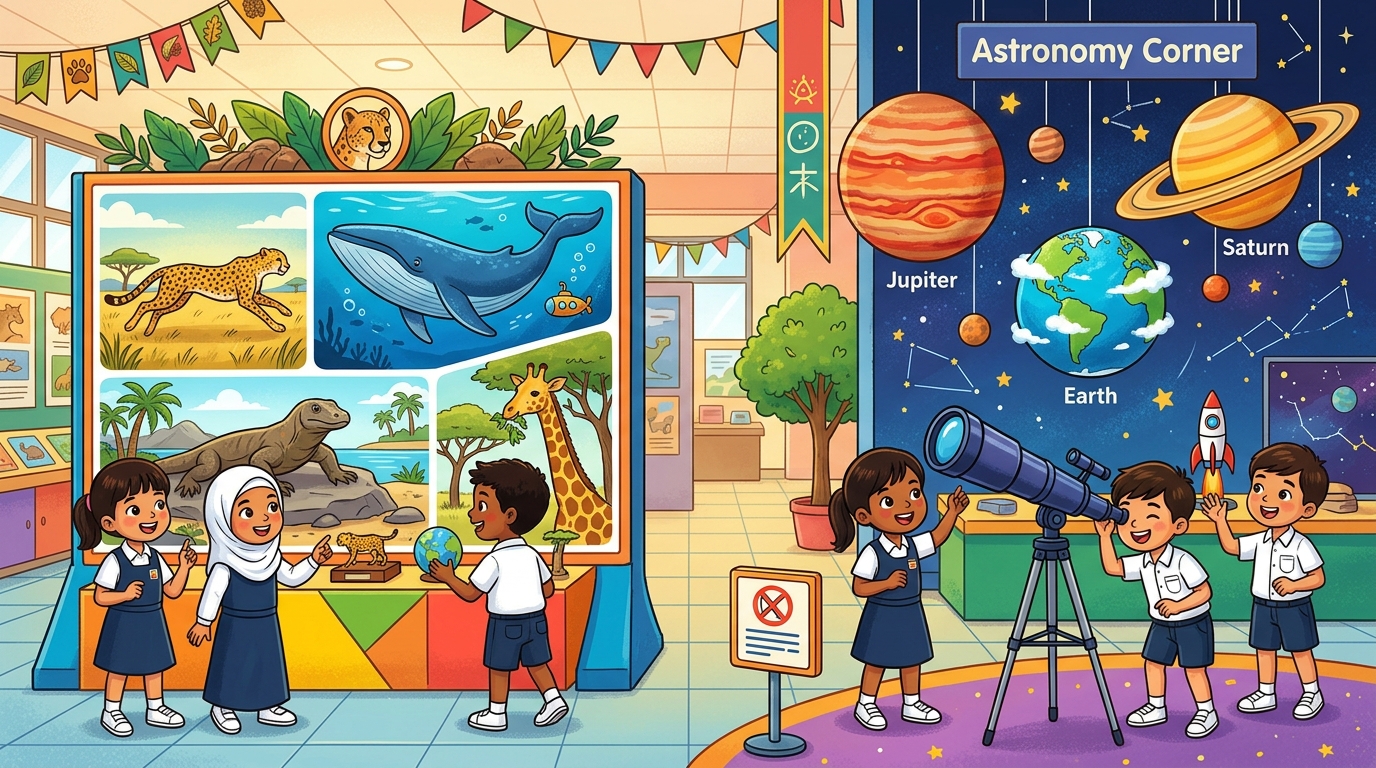
Picture: Children comparing the sizes of planets and animals at the science expo.
PART 1: Short Texts Reading Comprehension
Questions 1 to 5 · Read the notices, messages, and labels carefully. Choose the best answer.
5 Questions · 10 Marks
Question 1[2 Marks]
ANIMAL SPEED RECORD BOARD:
'Cheetah: 110 km/h (Fastest land runner)
Greyhound: 70 km/h
Lion: 80 km/h
*Note: Cheetahs have non-retractable claws that act like running spikes!'
Which animal is identified as the fastest land runner?
✓ Correct Answer: Option B
💡 Teacher's Explanation: The record board states: 'Cheetah: 110 km/h (Fastest land runner)'.
Question 2[2 Marks]
PLANET COMPARISON DISPLAY:
'Jupiter is the largest planet in our solar system. It is more than eleven times wider than the Earth and contains a massive swirling red storm.'
What is one key characteristic of Jupiter mentioned on the display?
✓ Correct Answer: Option C
💡 Teacher's Explanation: The display states: 'It is more than eleven times wider than the Earth'.
Question 3[2 Marks]
MARINE GIANTS NOTICE:
'The blue whale can reach up to 150 tonnes, making it much heavier than twenty African elephants combined!'
How heavy can a blue whale grow according to the notice?
✓ Correct Answer: Option C
💡 Teacher's Explanation: The text explicitly states: 'The blue whale can reach up to 150 tonnes'.
Question 4[2 Marks]
TELESCOPE VIEWING NIGHT NOTICE:
'Stargazing Session: Friday, 8:00 p.m. Observe the rings of Saturn through our high-powered astronomical telescope. Free admission for students!'
Which celestial object will visitors observe through the telescope on Friday?
✓ Correct Answer: Option A
💡 Teacher's Explanation: The notice states: 'Observe the rings of Saturn through our high-powered astronomical telescope.'
Question 5[2 Marks]
SCIENCE QUIZ BOOTH FLYER:
'Test your nature knowledge! Answer three comparative questions correctly to win a glow-in-the-dark solar system sticker sheet.'
What prize can participants win at the science quiz booth?
✓ Correct Answer: Option B
💡 Teacher's Explanation: The flyer says: 'win a glow-in-the-dark solar system sticker sheet'.
PART 2: Cloze Passage Grammar Filling
Questions 6 to 9 · Read the text below and choose the best word for each space.
4 Questions · 10 Marks
📖 Passage: Real-World Context & Grammar Focus
Pupils are visiting an interactive exhibition comparing outer space and animal giants. In our solar system, Jupiter is much (6) _______ than the Earth. Mercury is the (7) _______ planet to the fiery Sun. On land, the cheetah can run (8) _______ than a cheetah's predator, the lion. In the vast ocean, the blue whale is the (9) _______ animal that has ever lived on our planet.
Question 6[2.5 Marks]
Choose the best answer for blank (6):
✓ Correct Answer: Option B
💡 Teacher's Explanation: Comparing two objects (Jupiter and Earth) with 'than', we use comparative 'bigger'.
Question 7[2.5 Marks]
Choose the best answer for blank (7):
✓ Correct Answer: Option C
💡 Teacher's Explanation: With the definite article 'the', we use the superlative 'closest'.
Question 8[2.5 Marks]
Choose the best answer for blank (8):
✓ Correct Answer: Option B
💡 Teacher's Explanation: Comparing cheetah and lion speeds with 'than', we use comparative 'faster'.
Question 9[2.5 Marks]
Choose the best answer for blank (9):
✓ Correct Answer: Option A
💡 Teacher's Explanation: Superlative form 'the heaviest animal that has ever lived' (heavy -> heaviest).
PART 3: Linear Text Reading Comprehension
Questions 10 to 14 · Read the passage below and answer the questions that follow.
5 Questions · 15 Marks
📖 Fascinating Comparisons in Nature and the Cosmos
Nature and the cosmos are filled with astonishing extremes. When scientists compare the celestial bodies in our solar system, they discover dramatic differences in size, temperature, and composition.
Mercury is the closest planet to the Sun and also the smallest of the eight planets. However, Venus is actually hotter than Mercury because its dense atmosphere of carbon dioxide traps scorching heat like a greenhouse. In contrast, Jupiter is the undisputed giant of the planetary family. It is so immense that more than one thousand Earths could fit comfortably inside it! Further out in space, Saturn captivates astronomers as the prettiest planet because of its dazzling system of icy rings.
Remarkable comparisons also exist in the wildlife world. The African cheetah is the fastest runner on four legs, accelerating from zero to 90 km/h in just three seconds. In the oceans, the blue whale holds the crown as the largest and heaviest creature. Its tongue alone weighs as much as an adult elephant, and its heart is the size of a small car. Learning about these incredible records fills us with awe for the natural universe.
Question 10[3 Marks]
Why is Venus hotter than Mercury despite being further from the Sun?
✓ Correct Answer: Option B
💡 Teacher's Explanation: Paragraph 2 states: 'Venus is actually hotter than Mercury because its dense atmosphere of carbon dioxide traps scorching heat like a greenhouse.'
Question 11[3 Marks]
How many Earths could fit inside the giant planet Jupiter?
✓ Correct Answer: Option C
💡 Teacher's Explanation: Paragraph 2 states: 'more than one thousand Earths could fit comfortably inside it!'
Question 12[3 Marks]
What makes Saturn famous among astronomers?
✓ Correct Answer: Option B
💡 Teacher's Explanation: Paragraph 2 explains: 'Saturn captivates astronomers as the prettiest planet because of its dazzling system of icy rings.'
Question 13[3 Marks]
How quickly can an African cheetah accelerate from zero to 90 km/h?
✓ Correct Answer: Option A
💡 Teacher's Explanation: Paragraph 3 states: 'accelerating from zero to 90 km/h in just three seconds.'
Question 14[3 Marks]
How big is the heart of an adult blue whale?
✓ Correct Answer: Option C
💡 Teacher's Explanation: Paragraph 3 explicitly states: 'and its heart is the size of a small car.'
PART 4: Multiple Matching Information Transfer
Questions 15 to 19 · Read the three texts (A, B, and C) and match them to the statements.
5 Questions · 15 Marks
Person AMarcus
I presented on cheetah biomechanics. I demonstrated how cheetahs have flexible spines and wide nostrils that pump large amounts of oxygen into their lungs, allowing them to sprint faster than any racehorse.
Person BShanti
My presentation compared planetary sizes using fruits. I used a small green pea to represent Mercury, a cherry tomato for Earth, a huge watermelon for Jupiter, and a cantaloupe with a paper ring for Saturn.
Person CWei Lun
I made an interactive ocean chart comparing modern marine mammals. I showed that a newborn blue whale calf weighs three tonnes, which is heavier than a full-grown white rhinoceros!
Question 15[3 Marks]
Who used different fruits like a pea and a watermelon to show planetary scale?
✓ Correct Answer: Option B
💡 Teacher's Explanation: Shanti (B) used fruits (pea, cherry tomato, watermelon) to represent planets.
Question 16[3 Marks]
Who explained that a newborn whale calf is heavier than an adult white rhinoceros?
✓ Correct Answer: Option C
💡 Teacher's Explanation: Wei Lun (C) compared a whale calf's weight to a white rhinoceros.
Question 17[3 Marks]
Who explained how flexible spines and wide nostrils help cheetahs sprint fast?
✓ Correct Answer: Option A
💡 Teacher's Explanation: Marcus (A) demonstrated cheetah biomechanics with flexible spines and wide nostrils.
Question 18[3 Marks]
Who created an interactive ocean comparison chart of modern marine mammals?
✓ Correct Answer: Option C
💡 Teacher's Explanation: Wei Lun (C) created an interactive ocean chart comparing marine mammals.
Question 19[3 Marks]
Who used a cantaloupe with a paper ring to represent the planet Saturn?
✓ Correct Answer: Option B
💡 Teacher's Explanation: Shanti (B) used a cantaloupe with a paper ring for Saturn.
PART 5: Word Spelling with Clues
Questions 20 to 24 · Read the definition and spell the word correctly using the letters given.
5 Questions · 10 Marks
Question 20[2 Marks]
Clue: A large wild cat with black spots that is famous as the fastest land mammal.
Letter Hint: c _ _ _ _ _ h
✓ Correct Spelling: cheetah
💡 Teacher's Explanation: c-h-e-e-t-a-h (猎豹)
Question 21[2 Marks]
Clue: A huge celestial body that moves in an elliptical orbit around a star.
Letter Hint: p _ _ _ _ t
✓ Correct Spelling: planet
💡 Teacher's Explanation: p-l-a-n-e-t (行星)
Question 22[2 Marks]
Clue: A very large expanse of sea, in particular each of the main areas into which sea is divided.
Letter Hint: o _ _ _ n
✓ Correct Spelling: ocean
💡 Teacher's Explanation: o-c-e-a-n (海洋)
Question 23[2 Marks]
Clue: The curved path of a celestial object or spacecraft around a star or planet.
Letter Hint: o _ _ _ t
✓ Correct Spelling: orbit
💡 Teacher's Explanation: o-r-b-i-t (轨道/运行轨道)
Question 24[2 Marks]
Clue: An imaginary or real creature of immense size and extraordinary strength.
Letter Hint: g _ _ _ t
✓ Correct Spelling: giant
💡 Teacher's Explanation: g-i-a-n-t (巨人/庞然大物)
PART 6: Sentence Construction
Questions 25 to 28 · Construct a complete and grammatically correct sentence using the given words.
4 Questions · 20 Marks
Question 25[5 Marks]
🔤 Prompt Words: cheetah / be / faster than / any other land mammal
Write a complete and meaningful sentence based on the prompt words above:
✓ Standard Model Sentence: The cheetah is faster than any other land mammal.
💡 Teacher's Analysis: Comparative adjective structure: 'The cheetah is faster than any other land mammal.'
📋 Rubric: Capital letter & full stop (1m) + Subject-verb agreement (2m) + Accurate prompt word usage (2m)
Question 26[5 Marks]
🔤 Prompt Words: Jupiter / be / the largest planet / in / solar system
Write a complete and meaningful sentence based on the prompt words above:
✓ Standard Model Sentence: Jupiter is the largest planet in our solar system.
💡 Teacher's Analysis: Superlative adjective structure: 'Jupiter is the largest planet in our solar system.'
📋 Rubric: Capital letter & full stop (1m) + Subject-verb agreement (2m) + Accurate prompt word usage (2m)
Question 27[5 Marks]
🔤 Prompt Words: blue whale / be / heavier than / twenty African elephants
Write a complete and meaningful sentence based on the prompt words above:
✓ Standard Model Sentence: The blue whale is heavier than twenty African elephants.
💡 Teacher's Analysis: Comparative adjective structure: 'The blue whale is heavier than twenty African elephants.'
📋 Rubric: Capital letter & full stop (1m) + Subject-verb agreement (2m) + Accurate prompt word usage (2m)
Question 28[5 Marks]
🔤 Prompt Words: Venus / be / hotter than / Mercury / because of thick clouds
Write a complete and meaningful sentence based on the prompt words above:
✓ Standard Model Sentence: Venus is hotter than Mercury because of its thick clouds.
💡 Teacher's Analysis: Comparative with reason: 'Venus is hotter than Mercury because of its thick clouds.'
📋 Rubric: Capital letter & full stop (1m) + Subject-verb agreement (2m) + Accurate prompt word usage (2m)
PART 7: Guided Writing (Short Message & Paragraph)
Questions 29 to 30 · Write structured and cohesive responses based on the situations given.
2 Questions · 20 Marks
Question 29[10 Marks]
Write a short comparison paragraph (30 - 40 words) comparing two animals or two planets using comparative and superlative adjectives.
Include:
• Which one is bigger, faster, or heavier
• One notable feature of each
• Concluding thought
Write your response in the space below:
✓ Sample High-Scoring Response:
A cheetah is much faster than an elephant on land, sprinting up to 110 km/h with its slender body. However, an elephant is far bigger and heavier, possessing mighty tusks. Both creatures are wonderful wonders of nature!
📋 Official Marking Rubric:
Rubric (10 marks):
• Content (4 marks): Compares 2 subjects with comparative/superlative terms, specific features, conclusion.
• Language & Grammar (4 marks): Accurate comparative forms (-er than, more ... than), proper punctuation.
• Vocabulary & Spelling (2 marks): Appropriate comparison and science terminology.
Question 30[10 Marks]
Write a short informational caption card (25 - 35 words) for an exhibition poster explaining why Saturn is called the 'Jewel of the Solar System'.
Write your response in the space below:
✓ Sample High-Scoring Response:
Saturn is known as the Jewel of the Solar System because it has the most beautiful, shimmering rings made of ice and rock. Looking at Saturn through a telescope is an awe-inspiring experience!
📋 Official Marking Rubric:
Rubric (10 marks):
• Content (4 marks): Explains distinctive ring feature, reasons for the title, visual experience.
• Language & Grammar (4 marks): Superlative adjective and clear descriptive structures.
• Vocabulary (2 marks): Astronomy terms, correct spelling.